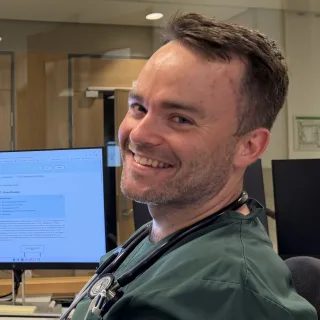
Erik Tungland
Accelerating surgical residency training in gastrosurgery through structured digital preparation.

The gastrosurgical department at Stavanger University Hospital (Stavanger Universitetssykehus) holds university hospital status through its affiliation with the University of Bergen. Erik Tungland works here as a Resident Doctor in Gastrointestinal Surgery, using Alfred Surgery on a regular weekly basis, alongside colleagues who share the same structured approach to preparation and post-operative feedback.
Erik: "Starting in surgery felt daunting. I was fortunate that my department leader connected me with our local Alfred Surgery instructor from day two. My background before this position was limited to what I had observed during my intern year and medical school, surgery had never been my primary focus, as I had originally planned to specialize in cardiology."
Just before starting, Erik felt genuinely underprepared. His core concerns were practical ones:
He assumed he would learn these things along the way, but still wanted to make a good impression and develop quickly. He bought a comprehensive surgical textbook, but it was far too broad and general, and with three young children at home, he simply didn't have the time to work through it.
Alfred was integrated from day one of residency as the primary preparation and feedback tool.
New residents at the gastrosurgical department receive an Alfred Surgery account when they start, along with a recommended starting point. The platform functions as both a pre-operative preparation environment and a shared reference tool during supervisor-led feedback sessions.
Residents gained access to:
"Speaking from my own experience: Alfred Surgery has dramatically accelerated my preparedness and learning curve." - Erik Tungland
Measurable improvements in readiness, independence, and learning curve.
Residents gained primary surgeon responsibility notably early in training, partly attributed to structured preparation in Alfred Surgery.
Step-by-step procedure overviews map directly onto the operative workflow, enabling residents to anticipate pitfalls at each stage rather than reacting to them.
Alfred Surgery's format naturally prompts attending surgeons to give more systematic debriefs, addressing each operative step specifically, rather than offering only general impressions.
Far less time-consuming than conventional surgical textbooks, and directly applicable to how procedures are performed locally and nationally, not just generically educational.
Key insights from surgical residency training at Stavanger.
"For my first procedures, prepared using Alfred Surgery, I already had a solid grasp of the steps and pitfalls, freeing me to focus on technique. The contrast becomes clear in procedures I haven't prepared on Alfred Surgery: I find myself spending mental energy on rationale rather than technique itself. I believe this would not have been possible had I been managing theory, technique, and situational awareness all at once."
- Erik Tungland, Resident Doctor at Stavanger University Hospital